Rewrite the Script · Grief, loss and hope
When Grief Comes, Where Will I Let My Mind Live?
Grief is real, but it doesn't have to become where we live. Faith doesn't erase grief. It reminds me that death doesn't have the final word.
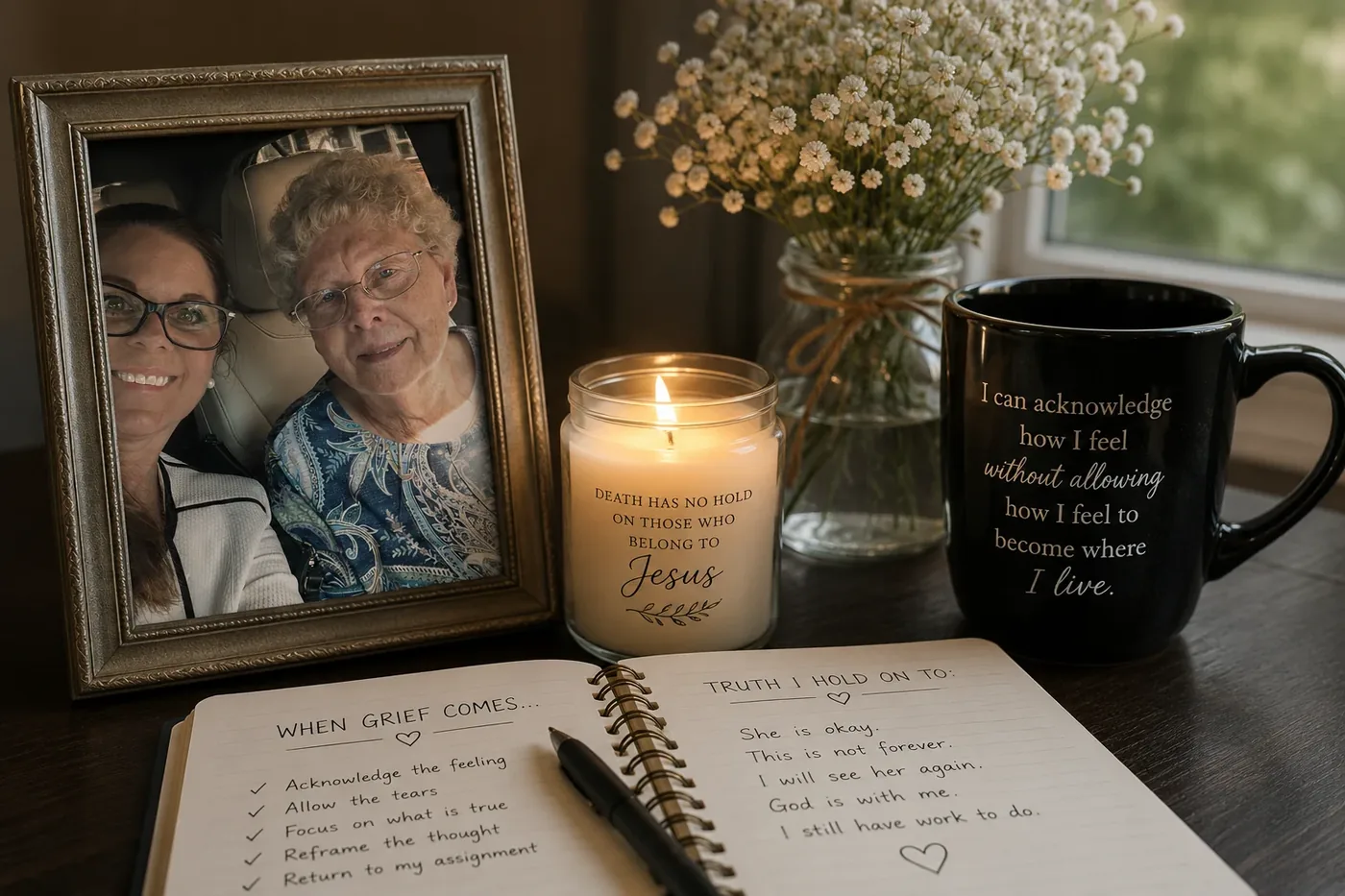
The other night, I was praying and talking to God about my mom. I wasn't really asking Him to take the grief away as much as I was trying to understand it. There are moments when I miss her so much that I can physically feel it.
A lump comes into my throat, a memory catches me unexpectedly, or I think about something I would have called to tell her. In those moments, the reality that I can't simply pick up the phone and hear her voice hits me all over again.
As I was talking to God about this, I kept coming back to something that has always fascinated me: Jesus wept when Lazarus died.
Jesus knew Lazarus wasn't staying dead. He knew exactly what He was about to do, and He certainly knew that death did not have the final word. Yet when Jesus saw Mary and the people around her weeping, Scripture tells us that He was deeply moved. Then Jesus wept.
Since losing my mom, I've thought about that moment differently.
If Death Has Been Defeated, Why Does It Hurt So Much?
First Corinthians 15:55 says, "O death, where is thy sting? O grave, where is thy victory?" If I believe what Scripture teaches about eternity, then I don't have to be afraid for my mom. She's okay. In fact, she's more than okay. The suffering and limitations she experienced here are gone, and because of Jesus, I believe the separation between us is temporary.
So if I believe all of that, what exactly am I grieving?
I'm grieving my experience of life without her here. I miss talking to her. I miss seeing her. I miss knowing she's only a phone call away. I miss the ordinary things that didn't seem nearly as precious when I still had them.
That realization has helped me understand my grief differently. I'm not grieving because I'm afraid of where Mom is or because I believe death won. I'm grieving because I miss having her here with me. There is an important difference between those two things.
Grief Is Real, But Where Is My Focus?
At one point, I found myself thinking that grief can almost feel "selfish," but that's really too harsh a word for what I mean. Grief itself isn't selfish. Love grieves. Jesus wept. What I'm beginning to recognize, however, is how easily grief can turn my focus inward if I'm not careful.
There is a difference between acknowledging what I feel and continually centering my thoughts on how I feel. I can acknowledge, I miss my mom. This hurts. I wish I could talk to her. Those things are true, and pretending they aren't true isn't faith.
The problem comes when I stay there.
If I spend hour after hour thinking about everything I've lost, my attention becomes increasingly centered on my own pain. I can't call her. She won't be here for this. I wish things were different. I don't know how I'm supposed to do this without her. Every one of those thoughts may be understandable, but if I continually rehearse them, my world can become smaller and smaller until all I can see is what I'm missing.
That's where I believe I have a choice. I can acknowledge how I feel without allowing how I feel to become where I live.
Jesus Didn't Tell Us Not to Grieve
There is another Scripture that I think we sometimes misunderstand. Paul writes in 1 Thessalonians 4:13 that we should not grieve "as others do who have no hope." He didn't say we wouldn't grieve. He said our grief would be different because we have hope.
That matters to me because faith doesn't require me to stop missing my mom. Faith simply reminds me that missing her isn't the whole story. I can cry and still have hope. I can miss her and still have peace. I can wish she were here and simultaneously be grateful that she is no longer suffering.
Grief tells me what I feel. Faith helps me decide where I focus.
That's the distinction I'm learning to make. I don't have to suppress grief, but I also don't have to surrender my focus to it.
Rewriting the Script of Grief
This is where "rewriting the script" has become very personal for me. When grief comes, instead of becoming afraid of the emotion or following it wherever it wants to take my thoughts, I'm learning to recognize what is happening.
I miss my mom. That's real. But then I remind myself of what else is true. She is okay. This separation isn't forever. God is still with me. I'm still here, and if I'm still here, there is still something God has given me to do.
Notice that I don't have to deny one truth in order to believe another. I miss my mom and she is okay. I wish she were here and I believe I will see her again. This hurts and God is with me. My life changed and my purpose didn't disappear.
Sometimes rewriting the script isn't replacing a painful thought with a happier one. Sometimes it's simply refusing to allow the painful truth to become the only truth we're thinking about.
What Do We Do When Grief Comes?
I'm still walking through this myself, but I'm learning that there are practical things I can do when grief catches me unexpectedly.
First, I can acknowledge the feeling instead of pretending it isn't there. I can say, I miss her today. I wish I could call her. This moment is harder than I expected. There is nothing wrong with naming what hurts.
I can also allow myself to feel it. Tears aren't evidence that I've lost my faith. Jesus wept. Feeling sadness isn't the problem. The question is what I do with my thoughts once the sadness arrives.
Then I can pay attention to where my mind is going. Am I simply acknowledging my loss, or have I begun rehearsing it? Am I remembering someone I love, or am I repeatedly focusing on everything I no longer have? For me, recognizing that shift is incredibly important because that's usually the moment when grief can begin pulling me deeper.
That's when I intentionally return my mind to what is also true. Mom is okay. This isn't forever. Death didn't win. God is still with me. There is still purpose in front of me. That's not positive thinking or pretending something painful didn't happen. It's intentionally bringing my thoughts back into agreement with what I say I believe.
And finally, I can return to my assignment.
That may be the most important part for me. I'm still here, and because I'm still here, there are people for me to love, words for me to write, people for me to encourage, and things God has asked me to do. My mom completed the portion of her earthly journey that was hers. I'm still living mine.
Continuing to live doesn't mean I'm leaving her behind. It means I'm honoring the life God has still entrusted to me.
Peace Requires Somewhere to Rest My Mind
Isaiah 26:3 says, "You keep him in perfect peace whose mind is stayed on you, because he trusts in you." That verse has taken on a different meaning for me because peace doesn't necessarily come when the circumstance changes. Some circumstances can't be changed. My mom isn't coming back tomorrow, and no amount of prayer or positive thinking changes that reality.
But I can decide where my mind will rest in the middle of a circumstance I cannot change.
If I keep my mind centered entirely on what I've lost, the weight of that loss can become heavier and heavier. That doesn't mean I should ignore my feelings. It means I don't have to continually feed them with my focus.
I can redirect my attention toward God, toward eternity, toward gratitude, toward the people still in front of me, and toward the purpose He has given me for today. I can remember my mom with love without making her absence the center of every day.
She mattered so much that I miss her terribly. But death doesn't get to take my mother and then take the rest of my life with her.
I still have a life God has entrusted to me. I still have people to love. I still have an assignment. And most importantly, I still have hope.
So when that lump comes into my throat again, and I'm sure it will, I don't have to panic about it or surrender the rest of my day to it. I can acknowledge what's happening and remind myself, I miss you, Mom. I love you. I wish you were here. But I know you're okay. I know this isn't forever. And until I see you again, I'm going to keep living the life God has given me.
Maybe that's part of what it means for death to lose its sting. It doesn't mean we never cry, never miss them, or never feel the pain of separation. Jesus Himself showed us that tears and faith can exist in the same moment.
It means that even while we grieve, death does not get the final word.
And it doesn't get to decide where we allow our minds to live.

Carole Mendoza
Christian life and business coach, speaker and author · Pooler, Georgia
Carole has coached, taught and spoken alongside people through seasons of growth, transition, leadership and change since 2019. She works one-on-one and with leaders and teams, in English and Spanish.
More about Carole →Carole wrote a book about these questions.
What Happens Next? was written for people who are grieving, questioning, believing or doubting.
Explore the books